Her Husband Had Her Locked Away for Thinking Too Loudly. She Got Out — and Changed the Law.
Photo: Jorge Royan, CC BY-SA 3.0, via Wikimedia Commons
Imagine waking up one morning in your own home, surrounded by your children, and by nightfall being committed to a psychiatric institution — not because anything is wrong with you, but because your husband decided your opinions were inconvenient. Now imagine that the law is entirely on his side.
This is not a hypothetical. This is what happened to Elizabeth Packard in the summer of 1860. And what she did about it is one of the most remarkable stories of individual defiance in American history.
The Crime of Having Her Own Mind
Elizabeth Ware Packard was forty-four years old and the mother of six children when her husband, a Calvinist minister named Theophilus Packard, decided she had become unmanageable. The specific trigger was her habit of attending Sunday school classes at their church in Manteno, Illinois, and offering opinions that differed from his theological views. She'd been exploring more progressive religious ideas. She said so, openly, in class.
 Photo: Theophilus Packard, via i.gr-assets.com
Theophilus did not take this well.
Under Illinois law at the time, a husband could commit his wife to a state asylum without her consent and without any medical evaluation, simply by requesting it. There was no hearing. There was no appeal. A wife was, legally, her husband's property — and if he decided she was insane, the state was prepared to take his word for it.
On June 18, 1860, Theophilus arrived at their home with the superintendent of the Illinois State Hospital for the Insane and two other men. Elizabeth was taken from her house by force, in front of her children, and transported to the asylum in Jacksonville, Illinois. She had committed no crime. She had received no diagnosis. She had simply been, in the eyes of her husband and the law, too loud in her thinking.
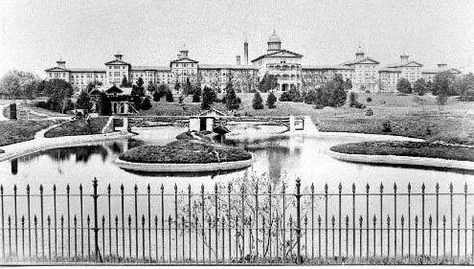 Photo: Illinois State Hospital for the Insane, via i.pinimg.com
Three Years Behind Locked Doors
What Elizabeth encountered inside the Illinois State Hospital was a system that had very little to do with healing and a great deal to do with control. Patients who insisted they were sane were routinely classified as more severely ill — because, the logic went, a truly insane person wouldn't recognize their own madness. It was a trap with no exit. The more forcefully Elizabeth argued for her release, the more her arguments were used as evidence against her.
She was not broken by this. She was educated by it.
Over three years, Elizabeth did something extraordinary: she started documenting everything. She wrote obsessively — observations about the treatment of patients, descriptions of abuses she witnessed, detailed accounts of the administrative procedures that kept women like her trapped. She hid her writing when she could. She protected it fiercely. The staff eventually noticed and confiscated some of her papers, but she kept writing.
She was building a case. She just didn't know yet exactly what kind.
The Trial That Wasn't Supposed to Happen
In 1863, after three years of confinement, Elizabeth was released — but not freed. Theophilus took her home to Manteno and locked her in a room, boarding up the windows. He planned to have her recommitted. What he hadn't counted on was that Elizabeth had spent three years in an asylum making friends, and some of those friends were on the outside.
Neighbors in Manteno, alarmed by her situation, filed a writ of habeas corpus on her behalf — a legal mechanism demanding that she be brought before a court to determine whether her imprisonment was lawful. It was an unusual step. It was also the crack in the wall that Elizabeth had been waiting for.
The trial that followed, in January 1864, was a sensation. Theophilus's lawyers argued that his wife was insane. Elizabeth's supporters argued the opposite — and Elizabeth herself was allowed to address the court. She spoke clearly, calmly, and with devastating precision. The jury deliberated for seven minutes before declaring her sane.
Seven minutes.
But winning her freedom was only the beginning.
The Woman Who Became Her Own Lobbyist
Theophilus, humiliated and furious, took the children and fled to Massachusetts, leaving Elizabeth with no home, no money, and no legal right to her own kids. Another person might have been finished. Elizabeth Packard was just getting started.
She wrote a book. Then another. Then another. Her self-published accounts of her asylum experience — raw, detailed, and written with the controlled fury of someone who had spent three years cataloging injustice — sold tens of thousands of copies. She used the proceeds to fund something unprecedented: a solo lobbying campaign targeting state legislatures across the country.
She traveled alone. She drafted legislation herself. She showed up at state capitols, requested meetings with legislators, and made her case in person, one lawmaker at a time. She was a middle-aged woman with no political connections, no formal legal training, and no organizational backing. She had her books, her testimony, and an absolutely immovable sense of purpose.
It worked.
Between 1867 and the early 1870s, Elizabeth Packard secured the passage of new mental health legislation in Illinois, Massachusetts, Iowa, Maine, and several other states. The laws she championed required that patients have the right to a hearing before commitment, that married women could not be institutionalized solely on a husband's word, and that patients had the right to send uncensored mail — a provision directly inspired by the confiscation of her own writing.
The Legacy That Outlived the Outrage
Elizabeth Packard lived until 1897. She spent the last three decades of her life as one of the most effective grassroots legal reformers of the nineteenth century — a fact that somehow didn't make it into most history books, possibly because the history books were largely written by men.
Her story anticipates so much of what would follow in American reform movements: the individual who, having been crushed by a broken system, turns that experience into an obsessive, methodical campaign to fix it. She didn't have allies in high places. She had something more durable — the specific, unignorable authority of someone who had lived the thing she was trying to change.
She was committed because she thought too freely. She got out because she thought even more freely. And then she made sure the door couldn't be locked behind anyone else the same way.
That's not a tragedy. That's a blueprint.