He Couldn't Read the Script. So He Rewrote How Hollywood Tells Stories.
There's a particular kind of cruelty in being a writer who struggles to read. Words swim. Lines blur. Pages that take most people ten minutes to absorb can eat up an hour, leaving behind frustration instead of comprehension. For a working screenwriter in Hollywood — an industry that runs on paper, on notes, on rewrites delivered overnight — that kind of challenge sounds less like a hurdle and more like a career-ending wall.
Except, for some people, walls have a way of becoming doors.
The Problem Nobody Talked About
For much of the twentieth century, dyslexia wasn't something you disclosed in a writers' room. You didn't raise your hand and explain that the words on the page rearranged themselves when you weren't looking. You found workarounds. You developed systems. You got very, very good at hiding.
Some of Hollywood's most commercially successful screenwriters spent years doing exactly that — quietly engineering their way around a neurological difference that the industry had no patience for. And in doing so, they accidentally built something the industry desperately needed: a way of thinking about story that lived entirely outside the written word.
Shane Black, the writer behind Lethal Weapon and Kiss Kiss Bang Bang, has spoken openly about the way his brain processes narrative differently from his peers. So has Rian Johnson, who has described his relationship with text as complicated at best. But perhaps no working writer embodies this paradox more completely than the late Gary Goldman — co-writer of Total Recall and Minority Report — who developed elaborate visual mapping systems to compensate for reading difficulties that, in a strange twist, made his scripts more cinematic than almost anyone else's.
The through line in all of these careers isn't just perseverance. It's something more interesting than that.
Thinking in Pictures Before It Was a Method
Temple Grandin famously described her autism as thinking in pictures — a phrase that later became a book title and a cultural shorthand for a whole category of non-linear cognition. Screenwriters with dyslexia often describe something remarkably similar, even if they arrived at it through frustration rather than philosophy.
When you can't rely on reading a script fluidly, you stop thinking in lines of dialogue. You start thinking in images. In spatial relationships. In the emotional architecture of a scene rather than its literal content. You ask yourself: what does this moment look like? before you ask what does this moment say?
For a visual medium like film, that's not a workaround. That's the whole job.
Directors will tell you that the best scripts aren't the ones with the cleverest dialogue — they're the ones where you can see the movie before a single frame is shot. The pacing lives in the white space. The tension lives in what's left out. These are instincts that take most writers years of craft education to develop. For writers who process text differently, they're often baked in from the start, born out of necessity.
The Index Card Revolution
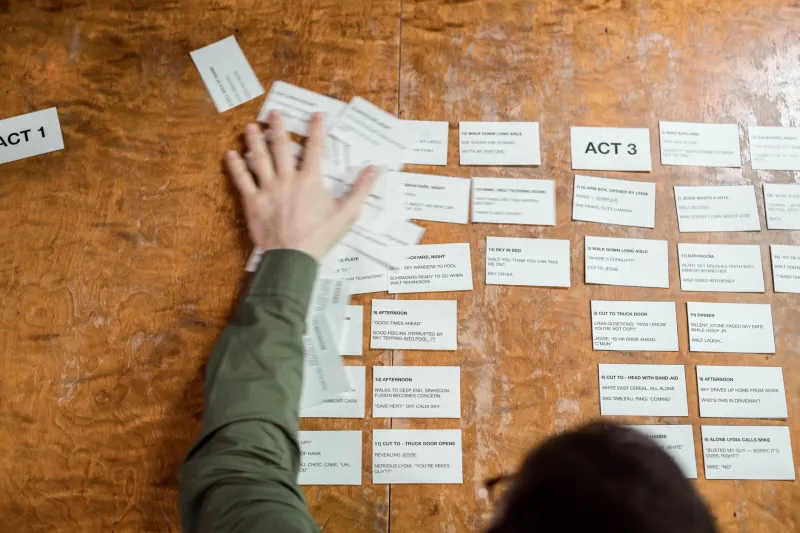
One of the most enduring tools in the modern screenwriter's toolkit is the index card method — breaking a story into discrete visual beats, arranging them on a wall or a corkboard, moving them around until the structure clicks. It's tactile. It's spatial. It's the opposite of sitting down and typing from page one to page one-hundred-and-ten.
The origins of this method aren't entirely documented, but its widespread adoption in Hollywood writing rooms tracks closely with the careers of writers who needed an alternative to linear text-based drafting. When you can't easily read back through twenty pages of your own work, you build systems that let you hold the whole story in your head at once — or at least on a wall in front of you.
What started as a coping mechanism became a craft standard. Today, virtually every professional screenwriting course teaches some version of the card method. Software like Final Draft and Celtx have built digital card boards directly into their interfaces. The entire industry has quietly adopted the workaround.
The Setback That Built the Skill
There's a temptation, when telling stories like this one, to reach for easy inspiration — to say that the disability was secretly a gift all along, that the struggle was secretly a superpower. That framing does a disservice to the very real difficulty of navigating a text-heavy profession with a brain that processes text differently.
But there's something genuinely worth sitting with here, which is this: the skills that make a great screenwriter — visual thinking, structural instinct, emotional economy — are not the skills that reading fluency rewards. Academic success rewards reading fluency. Hollywood rewards something else entirely.
Writers who couldn't rely on the traditional path to craft had to build their own. And the path they built turned out to be shorter, in some ways, to the thing the medium actually needs.
What the Room Never Knew
Many of the writers who developed these techniques did so quietly, never disclosing the reason behind their methods. A writer who says I prefer to pitch from cards rather than pages sounds organized and visual. A writer who says I struggle to read my own drafts sounds like a liability. Same reality, different framing.
The industry is slowly getting better at this — neurodiversity is a more openly discussed topic in creative workplaces than it was thirty years ago, and several prominent writers have spoken publicly about their dyslexia in recent years. But for a long time, the contribution was invisible. The workaround was all anyone saw.
The irony is that the workaround is now the standard. The techniques developed in secret, out of necessity, by writers who had no other option — those techniques are now taught in MFA programs as best practice.
The Lesson the Industry Is Still Learning
Hollywood has always been better at celebrating the finished product than interrogating how it got made. The screenplay that lands on the right desk at the right moment, that gets greenlit and shot and released and celebrated — nobody asks what the writer's relationship with text looked like at two in the morning when the draft was due.
But the stories behind the stories matter. They matter because they tell us something important about where creative breakthroughs actually come from — not from the smoothest path, but from the most resourceful detour.
The writer who couldn't read the script didn't fail at the job. He changed what the job looked like. And somewhere in a writers' room right now, someone is moving index cards around a corkboard, thinking they learned a technique in school.
They learned it from someone who had no other choice.