From the Wrong Side of the Law to the Right Side of History: Seven Fortunes Built on Illegal Foundations
Photo: Andre Carrotflower, CC BY-SA 4.0, via Wikimedia Commons
Business school teaches you market analysis, supply chain management, and how to write a pitch deck. It does not teach you what it feels like to run a distribution network in the dark, manage customer loyalty under existential pressure, or negotiate a deal when the stakes are your actual freedom. Some of America's most tenacious founders learned those things somewhere else entirely.
These seven stories aren't endorsements of lawbreaking. They're something more interesting: proof that the skills forged in illegal operations — street-level economics, risk tolerance, customer psychology, and the ability to improvise under pressure — can translate into something extraordinary when pointed in a legitimate direction.
1. The Moonshiner's Grandson Who Turned Bootleg Whiskey Into a Billion-Dollar Brand
The Brown family of Kentucky didn't advertise their early relationship with illegal liquor. But the craft, the recipes, and the distribution savvy that George Garvin Brown eventually used to build Brown-Forman — one of America's most enduring spirits companies and the home of Old Forester bourbon — owed something to a regional tradition of unlicensed distilling that had been a survival skill in Appalachian communities for generations.
What Brown did was recognize that the craft knowledge embedded in illegal production had genuine commercial value. He became the first distiller to sell bourbon sealed in bottles with a quality guarantee — a direct response to the adulteration and deception that plagued unregulated spirits. He used the underground's hard-won lessons about what customers actually wanted, and built a legal empire around delivering it honestly.
Brown-Forman still operates today, with revenues north of $3 billion annually.
2. The Numbers Runner Who Became Harlem's Most Unlikely Banker
In the early twentieth century, the numbers game — an illegal lottery that ran through Black urban neighborhoods — was one of the few financial systems accessible to communities that mainstream banks routinely refused to serve. Stephanie St. Clair, known in Harlem as "Madame Queen," ran one of the most sophisticated numbers operations in New York City during the 1920s and '30s.
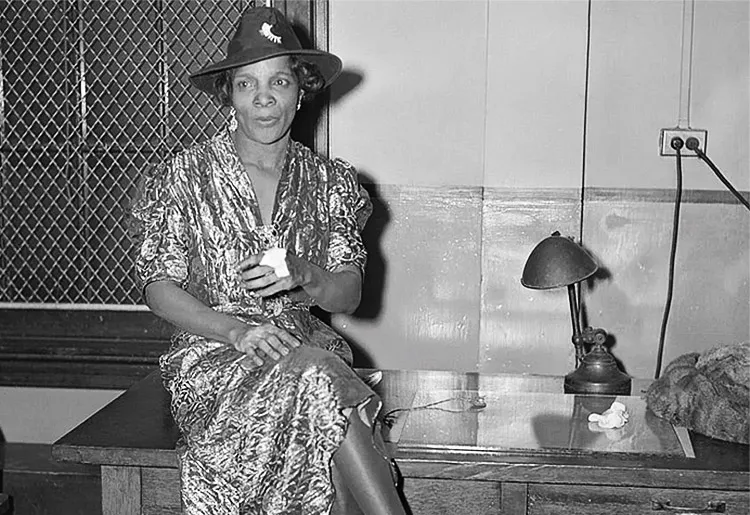 Photo: Stephanie St. Clair, via www.historyhit.com
What set St. Clair apart wasn't just her operational skill. It was her financial discipline. She kept meticulous records, paid out reliably, and built fierce customer loyalty in a business where trust was everything. When she eventually stepped back from the numbers trade — in part after a legendary feud with Dutch Schultz, who tried and failed to muscle her out — she'd accumulated enough capital and community credibility to pivot into legitimate real estate and advocacy work.
She used her platform to publicly expose police corruption and fight for her community's rights, funding her activism with the fortune she'd built in the underground economy. Harlem remembered her as a protector. The numbers game taught her how.
3. The Prohibition Smuggler Who Invented Modern Wine Distribution
When Prohibition ended in 1933, the American wine and spirits industry didn't rebuild itself from scratch. In many markets, it was rebuilt by the men who'd kept it running illegally for thirteen years. Ernest Gallo's family background in the California wine trade during Prohibition was complicated, and Gallo himself has been famously tight-lipped about those years.
What's undeniable is that when Ernest and his brother Julio founded E&J Gallo Winery in 1933 — with almost no capital and a handwritten pamphlet on winemaking they found in a public library — they built distribution networks with a speed and effectiveness that baffled competitors. Ernest's instinct for logistics, retail relationships, and market penetration was almost preternaturally developed for a man who had never run a legal business before.
Gallo became the largest wine producer in the United States. Ernest's early education in moving product through difficult channels didn't hurt.
4. The Fence Who Became a Legitimate Art Dealer
In 1960s Philadelphia, a young man named Manny Silverman (name changed) ran a fencing operation — buying and reselling stolen goods — out of the back of a pawnshop. He had an eye for value and a gift for fast, confident appraisal that made him indispensable to people who needed to move things quickly.
After a close call with federal charges, Silverman walked away from the operation and applied those same skills — rapid authentication, price negotiation, reading a room — to the legitimate antiques trade. Within a decade he was a respected dealer. Within two, he was consulting for auction houses.
His story, documented in a 1994 Philadelphia Magazine profile, is a quiet reminder that expertise doesn't care where it was acquired. The eye he trained in the back of a pawnshop was the same eye that later authenticated pieces for some of the country's most prestigious collections.
5. The Poker Hustler Who Built a Legitimate Financial Services Firm
Before Doyle Brunson was a World Series of Poker legend, he was running illegal poker games across Texas in the 1950s — a genuinely dangerous occupation that occasionally involved armed robbery, police harassment, and the kind of risk management that no textbook covers. What Brunson developed during those years was an almost supernatural ability to read people, calculate odds under pressure, and maintain composure when everything was on the line.
Brunson eventually moved his operation to Las Vegas when gambling became legal there, but several of his contemporaries from the Texas circuit took a different route: they applied their probabilistic thinking and risk-tolerance to legitimate financial markets. At least two former members of Brunson's early circle went on to careers in commodities trading, where their ability to assess risk and read behavioral cues gave them an edge that formally trained traders struggled to match.
 Photo: Las Vegas, via c8.alamy.com
The poker table, it turns out, is an excellent classroom for anyone who wants to understand how markets actually behave.
6. The Street Pharmacist Who Became a Legitimate Healthcare Entrepreneur
In the mid-1990s, a young man in Baltimore spent several years in the drug trade before a prison sentence interrupted his trajectory. What he carried out of that experience — beyond the obvious costs — was a sophisticated understanding of supply chain logistics, customer retention, and what it meant to serve a community that felt abandoned by legitimate institutions.
After his release, he channeled those operational instincts into a community pharmacy in a neighborhood that hadn't had one in years. He understood his customers not as a demographic but as people he'd grown up alongside. His pharmacy became a community anchor. He eventually expanded to three locations and became a vocal advocate for pharmaceutical access in underserved urban communities.
His name isn't famous. His work is.
7. The Counterfeiter Who Became a Security Printing Pioneer
Frank Bourassa spent years producing what experts later called some of the most technically sophisticated counterfeit U.S. currency ever seized — not because he needed the money, but because, by his own account, he wanted to see if he could. When Canadian authorities finally caught up with him in 2012, they recovered $250 million in fake bills.
After his release — in a deal that remains remarkable for its leniency — Bourassa didn't disappear. He went to work advising financial institutions and security printing firms on the exact vulnerabilities he'd exploited. His knowledge of paper composition, ink chemistry, and printing technique was, paradoxically, most valuable to the people trying to stop people like him.
He's now a consultant. The skills are the same. The application is the opposite.
The Pattern Underneath the Stories
None of these people should be held up as role models for the illegal portions of their careers. The costs — to themselves and to others — were real. But the through-line connecting all seven stories is undeniable: the skills that illegal operations demanded, and that these individuals developed under pressure, turned out to be exactly the skills that legitimate business rewards.
Risk assessment. Customer loyalty. Operational discipline. The ability to function when the stakes are existential.
Business school teaches those things in theory. The street teaches them in a way you don't forget.