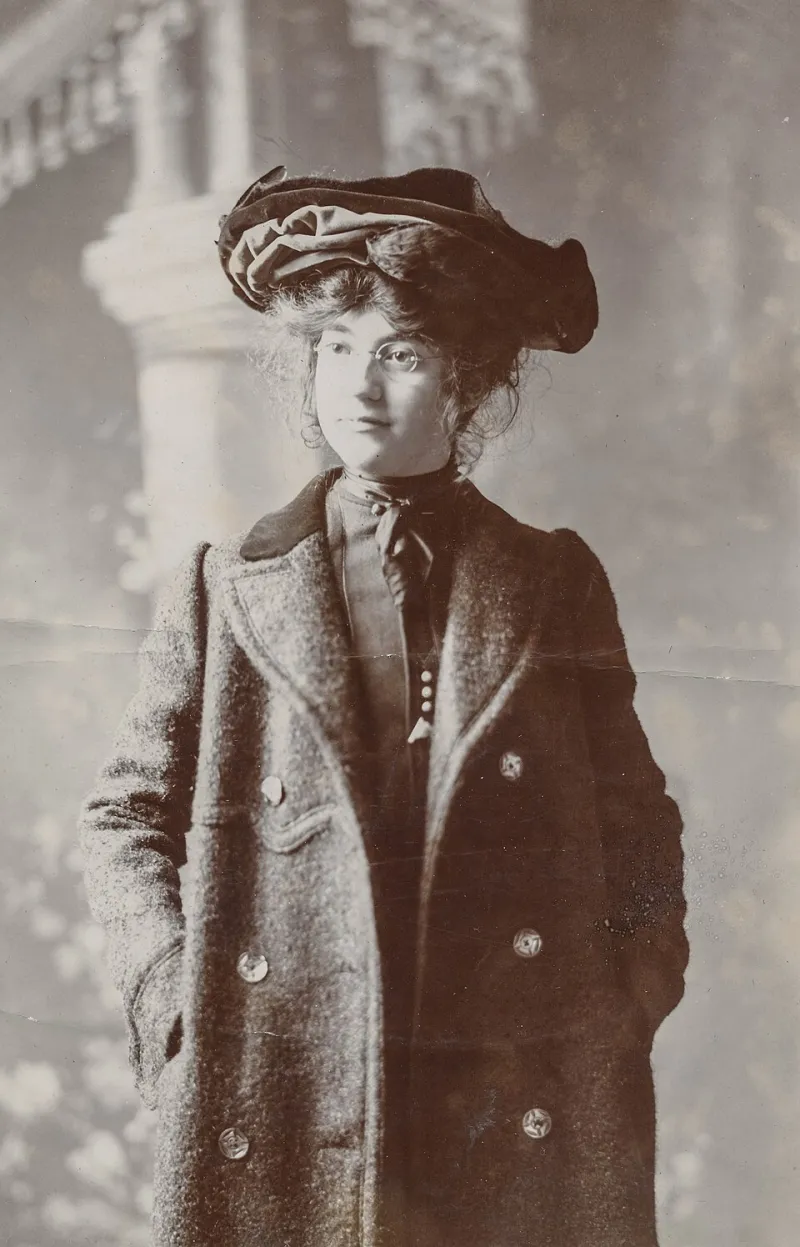
Photo: simpleinsomnia, CC BY 2.0, via Wikimedia Commons
Charlotte Smith had a simple goal: she wanted credit for what she'd built.
 Photo: Charlotte Smith, via i2-prod.birminghammail.co.uk
It was the 1870s, and Smith — a Washington, D.C. inventor and activist with a gift for righteous indignation — had begun to notice something deeply wrong with the way American innovation worked. Women were inventing things. Practical things. Useful things. Devices that improved domestic life, manufacturing processes, agricultural equipment, medical tools. And somewhere between the moment a woman filed her patent application and the moment the patent was issued, her name had a strange tendency to disappear.
 Photo: Washington, D.C., via onlybyland.com
Husbands received credit. Brothers received credit. Male business partners, male employers, male colleagues — all of them ended up holding patents for inventions that women had conceived and built. Sometimes this happened through outright fraud. Sometimes through the quiet assumption, baked into the system, that a woman probably hadn't really done the inventing herself. Either way, the result was the same: the ideas vanished from women's names and reappeared in men's.
Smith decided this was not going to stand.
A System Designed to Erase
To understand what Smith was fighting, it helps to understand how the patent system actually functioned in the post-Civil War era — and how thoroughly it was designed around assumptions that excluded women.
Married women in most states could not own property independently. That meant a patent — which was a form of intellectual property — could, in practice, be controlled or claimed by a husband. A woman who invented something while married was, legally speaking, in murky territory. The patent office didn't always make things clearer. Applications submitted by women were sometimes reassigned. Sometimes delayed until a male family member could be listed as co-inventor. Sometimes simply buried.
Single women had slightly more legal standing, but faced different obstacles: they were less likely to be taken seriously as inventors, less likely to have access to the capital needed to commercialize a patent, and less likely to have the legal resources to fight when their applications went sideways.
The women who did manage to get patents issued often found that enforcing them was another battle entirely.
Smith catalogued all of this. She gathered cases, interviewed women, documented patterns. She was building a record — not just of individual grievances, but of systemic theft.
The Woman Inventor, the Newsletter, and the Very Loud Campaign
In 1890, Smith launched a publication called The Woman Inventor. It was, as far as anyone can tell, the first periodical in American history devoted specifically to women in innovation — and it was not subtle about its purpose. Smith used it to publicize cases of patent fraud, name the men who had benefited from it, and build a constituency of women inventors who understood that their individual experiences were part of a larger pattern.
 Photo: The Woman Inventor, via www.citimuzik.com
The newsletter also served as a kind of organizing tool. Smith was tireless in her correspondence, her lobbying, and her willingness to show up in rooms where she wasn't expected or entirely welcome. She petitioned Congress. She testified. She wrote letters to anyone who might listen and quite a few people who clearly would have preferred not to.
She was, by most accounts, an exhausting person to oppose. She combined genuine legal knowledge with an activist's instinct for publicity and a stubborn refusal to accept procedural dismissals as final answers.
What She Was Actually Arguing
Smith's core argument was elegant in its simplicity: if the patent system existed to encourage innovation by guaranteeing inventors the right to benefit from their work, then a patent system that systematically stripped women of that right wasn't just unfair — it was economically self-defeating. America was leaving enormous amounts of intellectual capital on the table by creating conditions where half the population had no reliable protection for their inventions.
This was a savvy framing. It moved the argument beyond women's rights — which, in the 1870s and 1880s, was still a politically radioactive phrase in many quarters — and into the language of economic efficiency and national interest. Smith was essentially telling Congress: you built this system to make America more innovative. You are actively making it less innovative by allowing this to continue.
She also pointed out, with characteristic bluntness, that the men benefiting from reassigned patents weren't just stealing from individual women. They were distorting the historical record of American invention. Future generations would look back and see a landscape of male innovation that was, in significant part, a fiction.
The Slow, Grinding Work of Changing a System
Smith didn't win quickly. Institutional change rarely works that way.
But her campaign had effects that accumulated over time. Congressional hearings were held. The patent office came under increased scrutiny. Legal reforms in the latter half of the nineteenth century — including changes to married women's property rights that had been building for decades — gradually improved the conditions under which women could hold and defend patents.
The number of patents issued to women grew steadily through the 1880s and 1890s. Some of that growth reflected more women inventing. Some of it reflected a system that was, slowly and reluctantly, being forced to acknowledge inventions that had always been there.
Smith's specific contribution is hard to measure with precision, the way it's always hard to measure the impact of advocacy work. You can't run the counterfactual. But the record is clear that she pushed, publicly and persistently, at a moment when pushing mattered — and that the intellectual property protections that female inventors began to access in greater numbers in the late nineteenth century owe something to her fury.
The Longer Shadow
Charlotte Smith is not a household name. She probably should be.
The questions she raised — about who gets credit for innovation, about how institutional systems can be structured in ways that redirect intellectual property away from its actual creators, about the gap between a system's stated purpose and its real-world effects — are questions that didn't go away when she stopped asking them. They're questions that patent attorneys, technology companies, and policy makers are still wrestling with today.
She was a woman with an invention and a grievance who decided that the grievance was too important to keep to herself. She built a publication, a network, and a legal argument out of her anger. She went to war with a bureaucracy that had every structural advantage over her.
And she moved it. Not all at once, not completely, not without cost. But she moved it.
That's the thing about setbacks. Sometimes the person they happen to is exactly the wrong person to accept them quietly.