The Widow's Invention: How Fine China and Broken Dreams Built the Machine in Every American Kitchen
The Last Dinner Party
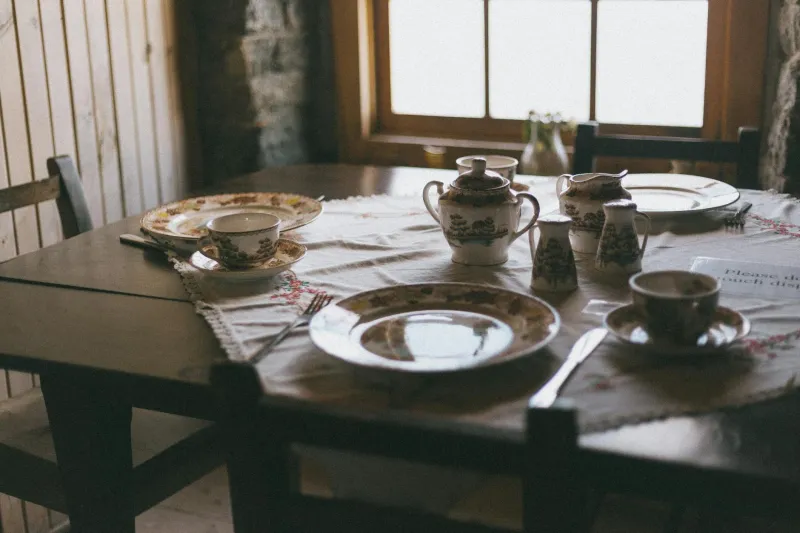
Josephine Cochrane threw elegant dinner parties. It was what wealthy women did in 1883 Shelbyville, Illinois—they entertained with their finest china, their most delicate crystal, their most impressive silver. The Cochrane home was known throughout the county for its gracious hospitality and, especially, for Josephine's prized collection of china that had been passed down through her family for generations.
 Photo: Josephine Cochrane, via www.seekpng.com
 Photo: Shelbyville, Illinois, via i.pinimg.com
Then came the dinner party that changed everything.
Josephine was in the kitchen after her guests had gone home, surveying the mountain of dirty dishes, when she heard it—the unmistakable sound of fine porcelain hitting the stone floor. Her servants, rushing to clean up after the evening's festivities, had dropped and shattered a piece of her great-grandmother's china.
It wasn't the first time. It wouldn't be the last. But that night, something in Josephine snapped. "If nobody else is going to invent a dishwashing machine," she announced to her startled husband William, "I'll do it myself."
William laughed. He shouldn't have.
When the Money Ran Out
Two years later, William Cochrane was dead, and Josephine discovered that her husband's successful dry goods business had been hiding a catastrophic secret: they were broke. Not just financially strained—completely, utterly bankrupt. The elegant home, the dinner parties, the lifestyle that had defined her identity for twenty years—all of it had been built on borrowed money and false promises.
At forty-five years old, Josephine found herself alone, in debt, and facing a choice that would have broken most women of her era: sell everything and live quietly on whatever charity her family could provide, or figure out how to support herself in a world that offered women precious few options.
But Josephine remembered something from that last dinner party. She remembered her promise to invent a dishwashing machine. More importantly, she remembered that she'd already started sketching designs.
The Woodshed Laboratory
Behind the Cochrane home stood a small woodshed that William had used for storing tools and equipment. After his death, Josephine claimed it as her workshop. Neighbors thought grief had affected her mind—what could a society woman possibly need with hammers and wire and mechanical drawings?
Josephine knew exactly what she needed them for. She was going to build a machine that would wash dishes without breaking them, using water pressure and mechanical precision instead of human hands. The concept wasn't entirely new—other inventors had tried similar devices—but they had all failed for the same reason: they treated dishwashing like a manufacturing process instead of understanding it as a delicate operation.
Josephine's insight was different. She understood dishes because she owned good ones. She knew that different shapes needed different handling, that fine china required gentler treatment than everyday pottery, that the real challenge wasn't just getting dishes clean—it was getting them clean without destroying them.
The Machine That Worked
Working mostly at night (propriety demanded that a widow's mechanical experiments remain as private as possible), Josephine designed a system of wire compartments that would hold dishes securely while jets of hot, soapy water sprayed them clean. She tested pressure levels, adjusted spray angles, and rebuilt the mechanism dozens of times.
The breakthrough came when she realized that the machine needed to accommodate the dishes, not the other way around. Instead of forcing all dishes into identical slots, she created adjustable compartments that could handle everything from teacups to serving platters.
By late 1885, Josephine had built a working prototype. It was crude, loud, and required someone to pump water by hand, but it worked. More importantly, it worked without breaking anything.
The real test came when she invited her skeptical neighbors to watch a demonstration. She loaded the machine with her remaining good china—a risk that represented everything she had left—and turned it on. Eight minutes later, she opened the machine to reveal perfectly clean, completely intact dishes.
The women who watched that demonstration became her first customers.
The Patent Office Problem
Getting a patent in 1886 required more than just having a good invention—it required being taken seriously by a system that assumed women weren't capable of mechanical innovation. When Josephine arrived at the patent office with her detailed drawings and working model, the clerks initially assumed she was there on behalf of her husband.
When she explained that she was the inventor and that her husband was dead, they suggested she might be confused about who had actually created the device. Surely a man had helped her? A brother, perhaps? A male friend with mechanical knowledge?
Josephine's response was swift and sharp: "I invented this machine because I wanted to keep my china from being broken by careless servants. I drew every line of the plans myself. I built the prototype myself. If you'd like to challenge my understanding of my own invention, I'd be happy to explain how every component functions."
She got her patent on December 28, 1886. Patent number 355,139 was issued to "Mrs. W.A. Cochrane" because even in victory, the system couldn't quite bring itself to acknowledge that Josephine was the inventor, not her dead husband's widow.
The World's Fair Breakthrough
Patent in hand, Josephine faced her next challenge: convincing manufacturers to produce her machine. Company after company rejected her design. The market was too small, they said. Households would never pay for such a device. Women didn't understand enough about machinery to operate it safely.
Josephine's solution was characteristically direct: if manufacturers wouldn't take her seriously, she'd find customers who would. She started targeting hotels and restaurants, businesses that washed hundreds of dishes daily and understood the value of efficiency and unbroken crockery.
The breakthrough came at the 1893 World's Fair in Chicago. Josephine rented space in the Women's Building and demonstrated her machine to thousands of visitors. Restaurant owners watched in amazement as her device cleaned dishes faster and more thoroughly than any human crew. Orders started pouring in.
 Photo: World's Fair in Chicago, via voxorb.com
By the end of the fair, Josephine had sold dozens of machines and established her company, the Garis-Cochran Manufacturing Company, as a serious player in commercial kitchen equipment.
The Home That Forgot Her Name
Josephine spent the rest of her life improving and promoting her invention, but she never lived to see dishwashers become standard in American homes. That transformation happened gradually through the 20th century, as her patents were sold, her company was absorbed by larger manufacturers, and her name was slowly erased from the story.
By the 1950s, when dishwashers finally became common in suburban kitchens, most Americans had no idea they were using a machine invented by a widowed socialite in a backyard woodshed. The marketing focused on convenience and modernity, not on the woman who had solved a problem that nobody else had even recognized.
Today, nearly every American kitchen contains some version of Josephine Cochrane's invention. The mechanics have been refined, the materials improved, the efficiency increased, but the basic principle remains exactly what she designed in 1885: secure compartments, pressurized water, and the understanding that good dishes deserve careful handling.
The Legacy in Every Kitchen
Josephine Cochrane's story isn't just about inventing a machine—it's about recognizing that the problems women face daily are engineering challenges waiting to be solved. She saw broken china where others saw careless servants. She saw a mechanical solution where others saw an unchangeable fact of domestic life.
Most importantly, she proved that innovation doesn't require formal training or institutional support—it just requires paying attention to problems that everyone else has learned to accept. Sometimes the best inventions come from people who are tired of living with things the way they are.
The next time you load your dishwasher, remember Josephine Cochrane—the widow who refused to accept that fine china had to be washed by hand, that women couldn't be inventors, or that grief had to mean giving up on the future. She built her solution in a woodshed, fought for her patent in a system that didn't believe in her, and created a device that makes life a little bit easier for millions of people every single day.
She never got to see her machine in every American kitchen. But every time someone loads their dishwasher and walks away, trusting that their dishes will come out clean and unbroken, they're proving that Josephine Cochrane was right all along.