Every Door Was Closed. So She Built Her Own House — and Called It an Empire.
Fashion has always had a very specific idea of what it wants to be. Slim. European. Expensive in a way that feels effortless. Rooted in a tradition that, by design, excludes far more people than it includes. The great fashion houses didn't build their prestige by being welcoming. They built it by being impenetrable.
So when a young designer with an unconventional aesthetic, a non-Western background, and a political situation that made her a liability showed up at the gates of that world, the answer was exactly what you'd expect.
No.
And then: no, again.
And then something more final than no — a government decree that made staying in her own country impossible.
What happened after that is one of the stranger and more quietly remarkable stories in the history of modern fashion.
The Aesthetic Nobody Wanted
To understand why the doors closed, you have to understand what she was bringing to them. Where the dominant fashion conversation of her era was obsessed with minimalism — clean lines, neutral palettes, the studied absence of decoration — her work was abundant. Layered. Rooted in textile traditions that European buyers didn't have the vocabulary to categorize and therefore didn't know how to sell.
The rejection letters, when she received them, used words like too much and not commercial and, in one case, interesting but not for us. The subtext was legible to anyone paying attention: this doesn't fit the story we're already telling.
She revised. She simplified. She tried to meet the industry where it was. The answer remained the same.
What she couldn't have known at the time — what nobody could have known — was that the aesthetic they were rejecting would, within two decades, become one of the most sought-after directions in luxury fashion. The layering, the craftsmanship, the connection to non-Western making traditions — these would eventually become the things that a new generation of buyers actively sought out, that sustainability-conscious consumers would pay a premium for, that major fashion publications would dedicate entire issues to celebrating.
But that was later. First came the exile.
Driven Out, Not Defeated
The political situation that forced her to leave varied in its specifics from the creative rejection she'd already experienced, but the emotional logic was identical: you don't belong here. The message, delivered this time not by a fashion editor but by a government, was the same one she'd been receiving for years.
She left with very little. A suitcase. Some fabric samples. The kind of resourcefulness that only develops in people who've had to be resourceful for a long time.
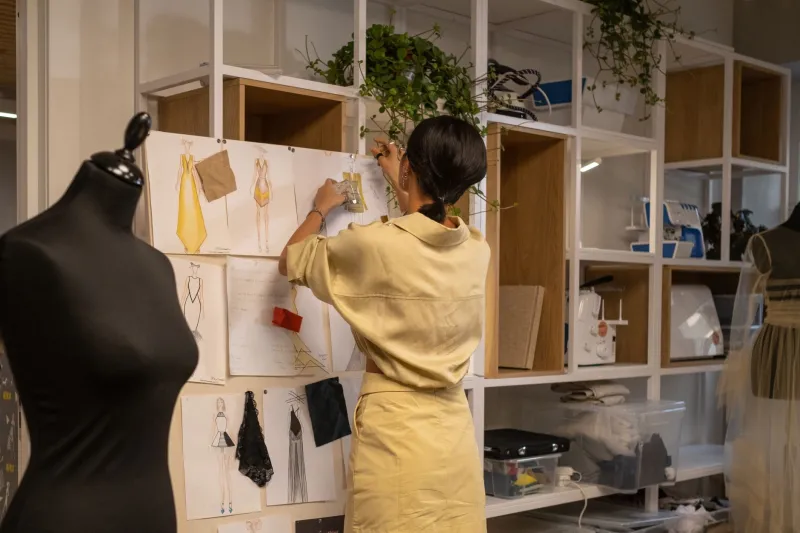
The garage — and it really was a garage, in the unglamorous American sense of the word, a utilitarian space that smelled like motor oil and had no natural light — became her studio. She sourced materials from places the industry didn't look. She built relationships with artisans whose skills were being devalued by the fast-fashion economy. She made things slowly, carefully, in ways that couldn't be easily replicated by a factory.
At the time, this looked like limitation. Later, it would look like strategy.
The Accidental Blueprint for Sustainable Luxury
Sustainability in fashion is now a marketing category with its own awards shows and certification bodies and editorial beats. Every major house has a sustainability report. Net-a-Porter has a conscious section. Consumers under forty, study after study confirms, factor environmental impact into their purchasing decisions in ways their parents simply didn't.
None of that infrastructure existed when she was working in a garage, sourcing ethically because she had no other option, making slowly because she couldn't afford to make fast, building community with makers because she had no access to the industry's established supply chains.
She wasn't making a statement. She was making a living.
But the model she built out of necessity turned out to be almost perfectly aligned with where the market was heading. Small-batch production. Artisan partnerships. Materials with traceable origins. A brand story rooted in real displacement and real craft rather than manufactured heritage. These weren't trends she anticipated — they were constraints she worked within. The fact that they eventually became the most desirable attributes in luxury fashion is one of those reversals that sounds too neat to be true and is, nonetheless, exactly what happened.
What Exile Teaches You That Success Never Could
There's a particular kind of clarity that comes from having nothing to lose and no one to impress. When you're not trying to get into an industry, you're free to build something that doesn't look like that industry. When you're not trying to win the approval of gatekeepers, you stop designing for gatekeepers and start designing for the people who actually connect with what you make.
This is the counterintuitive gift of exile, professional or geographic: it removes the ceiling by removing the floor. You're not climbing toward anything. You're building from scratch, which means you get to decide what the structure looks like.
Her brand, when it finally reached the scale that made the industry take notice, didn't look like anything else on the market. It couldn't — it had been built in conditions that no established house had ever operated in. The supply chains were different. The production philosophy was different. The relationship between the brand and its community of makers was different in ways that couldn't be quickly copied, because they'd been built over years, through relationships formed in circumstances that no well-funded fashion house would ever find itself in.
The Industry That Rejected Her Is Now Trying to Catch Up
The great fashion houses are, at this point, spending significant money trying to build what she built by accident. Sustainability consultants. Artisan partnership programs. Supply chain transparency initiatives. The language of craft and provenance and ethical making that now appears in every luxury brand's marketing copy.
She didn't invent sustainable luxury as a concept. But she demonstrated that it could be commercially viable, that there was a customer for it, that the market wasn't as narrow as the establishment had assumed. The industry that closed its doors to her spent the next twenty years trying to walk through the one she built.
There's no clean moral here about rejection being secretly good or hardship being secretly a gift. The exile was real. The loss was real. The years of working in a space that was never designed for the work she was trying to do — those were hard years.
But the business that came out of them was something the industry couldn't have produced on its own. It took someone who had no other option, building something that had no precedent, in a place nobody was watching.
That's usually how the blueprints get written.