Locked Out of Medicine, She Unlocked the Secret That Saved a Generation
Fifty Rejections and Counting
In 1928, Dorothy Crowfoot submitted her application to Harvard Medical School with the kind of grades that should have guaranteed admission. She had graduated summa cum laude from Bryn Mawr, published research as an undergraduate, and earned glowing recommendations from her professors.
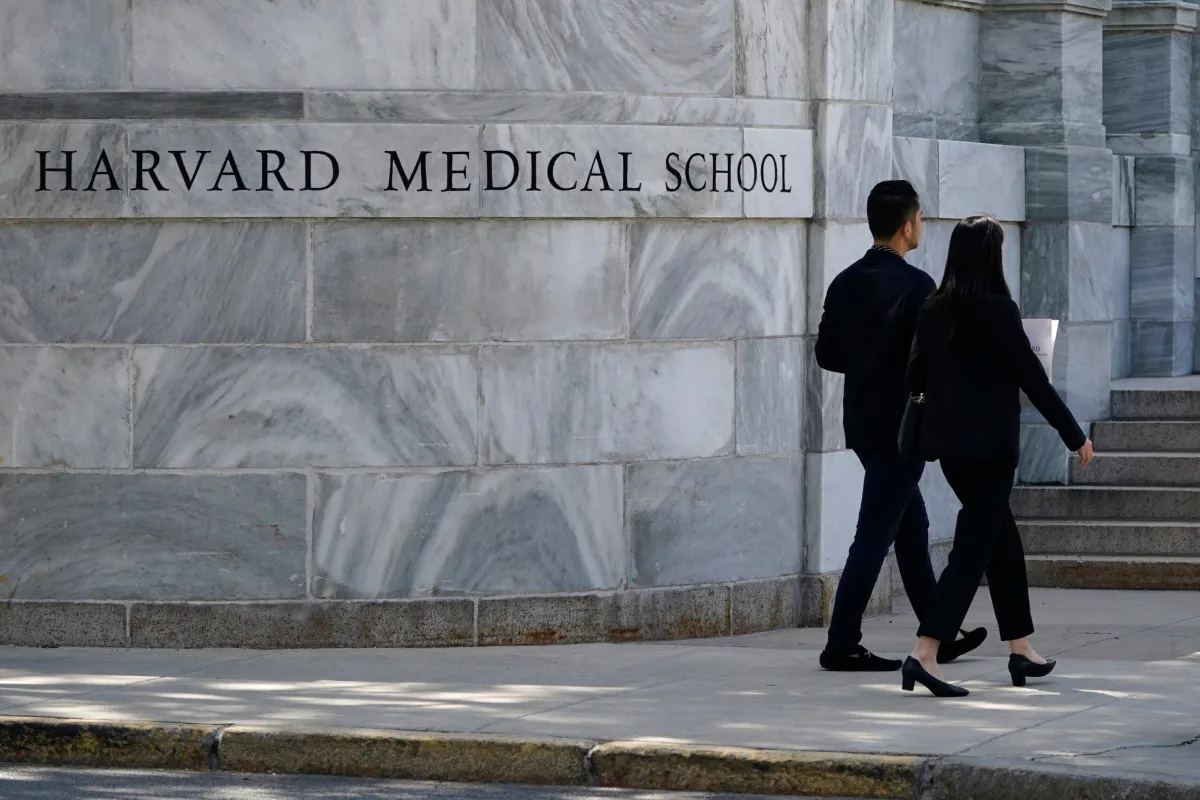 Photo: Harvard Medical School, via www.boston.com
 Photo: Dorothy Crowfoot, via data.docslib.org
The rejection letter was polite but firm: Harvard didn't accept women in their medical program.
She tried Yale. Rejected. Columbia. Rejected. Johns Hopkins. Rejected.
By the time she had collected her fiftieth rejection letter, Dorothy had a choice to make: give up on science entirely, or find another way in.
She chose the back door.
The Accidental Chemist
Unable to pursue medicine directly, Dorothy enrolled in Oxford's chemistry program—one of the few scientific fields that reluctantly admitted women. She told herself it was temporary, a stepping stone to eventually getting into medical school.
She had no way of knowing that this "temporary" detour would lead her to solve one of the most important puzzles in medical history.
At Oxford, Dorothy discovered X-ray crystallography, a technique so new and experimental that most established scientists dismissed it as impractical. The process involved bombarding crystals with X-rays and interpreting the resulting diffraction patterns to determine molecular structure—like solving a three-dimensional jigsaw puzzle where half the pieces were invisible.
It was tedious, uncertain work that could take years to yield results. Perfect for someone who had already learned that the conventional path wasn't available to her.
The Molecule That Changed Everything
In 1945, Dorothy received a sample that would define her career: crystallized penicillin. Alexander Fleming had discovered the antibiotic's bacteria-killing properties in 1928, but no one understood exactly how it worked. Without knowing penicillin's precise molecular structure, chemists couldn't synthesize it reliably or modify it to create more effective versions.
This was the kind of problem that medical researchers had been trying to solve for nearly two decades. Dorothy approached it from the outside, using techniques that most medical professionals had never heard of.
Working with equipment that was primitive even by 1940s standards, she began the painstaking process of mapping penicillin's molecular architecture. Each X-ray photograph required hours of precise calculation. Each calculation brought her slightly closer to understanding how this miraculous drug actually worked.
Seeing the Invisible
The breakthrough came in 1949, after four years of analysis. Dorothy had successfully determined penicillin's complete molecular structure—the first time anyone had mapped such a complex biological molecule using X-ray crystallography.
The implications were staggering. Understanding penicillin's structure meant that chemists could finally synthesize it artificially, making the drug cheaper and more widely available. More importantly, they could now modify its structure to create new antibiotics tailored for specific infections.
Dorothy's work didn't just solve the penicillin puzzle—it created an entirely new approach to drug discovery. Instead of relying on trial and error, scientists could now design medications by understanding exactly how molecules interacted with biological systems.
The Outsider's Advantage
What made Dorothy's achievement so remarkable wasn't just its scientific importance—it was how her outsider status had actually enabled the discovery. Medical researchers approaching the penicillin problem were constrained by conventional thinking about drug development. They looked for solutions within established frameworks.
Dorothy, locked out of those frameworks, had been forced to develop entirely new methods. Her background in pure chemistry, rather than applied medicine, gave her a different perspective on how molecules behaved. Her experience with X-ray crystallography, a technique most medical researchers ignored, provided the exact tool needed to crack the problem.
Every door that had closed to her had pushed her toward the one path that led to the answer.
Recognition, Finally
By the 1950s, Dorothy's work had revolutionized both chemistry and medicine. She had mapped the structures of vitamin B12 and insulin, discoveries that led directly to treatments for pernicious anemia and diabetes. Her techniques were being used in laboratories around the world to understand and develop new drugs.
In 1964, she became the first woman to win the Nobel Prize in Chemistry, recognized for work that had fundamentally changed how humanity approaches disease.
The Nobel Committee's citation was notably specific: they praised her determination of the structures of important biological substances. But they could have added a more personal note—they were honoring a woman who had been told she didn't belong in science and had responded by redefining what science could accomplish.
The Questions We Don't Ask
Dorothy Hodgkin's story forces us to confront an uncomfortable question: how many breakthroughs have we missed because we kept the wrong people out of the room?
Her systematic rejection from medical schools wasn't unusual for the 1920s and 1930s. Medical education was designed to exclude women, minorities, and anyone who didn't fit a narrow definition of who could become a doctor. The assumption was that these exclusions maintained standards and protected the profession's integrity.
But Dorothy's career suggests a different possibility: that the greatest innovations often come from people forced to approach problems from unconventional angles. Her outsider status wasn't a handicap to overcome—it was the exact perspective needed to see solutions that insiders had missed.
The Structure of Innovation
Today, Dorothy Hodgkin's techniques are fundamental to modern drug development. Every new medication goes through structural analysis using methods she pioneered. Her work on penicillin laid the groundwork for the entire antibiotic revolution that has saved hundreds of millions of lives.
But perhaps her most important contribution wasn't scientific—it was proof that innovation often comes from the margins, from people who have been told they don't belong but refuse to accept that verdict.
Sometimes the best way to solve a problem is to approach it from a direction that everyone else has dismissed as impossible. Sometimes being locked out of the traditional path forces you to find the better one.
And sometimes fifty rejections aren't the end of your story—they're just the beginning of a different, more important chapter.