The Late Student Who Accidentally Cracked Math's Greatest Mysteries
The Power of Not Knowing It's Impossible
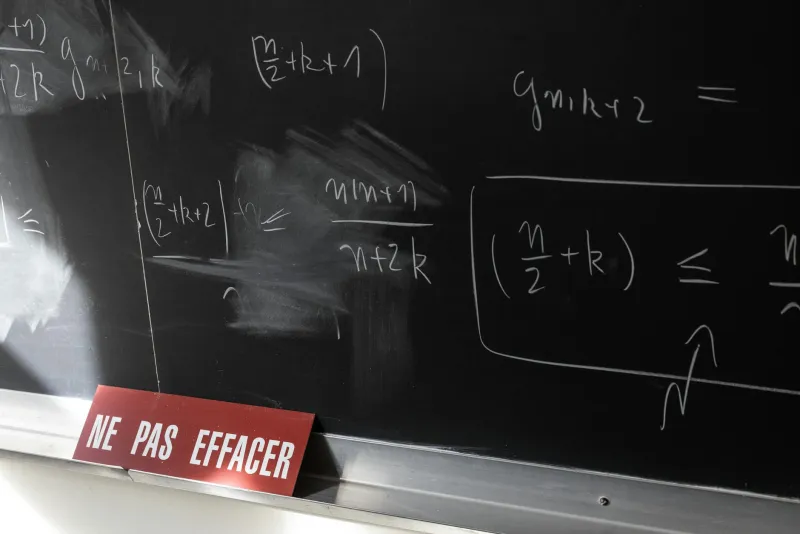
Sometimes the biggest breakthroughs come from people who don't know they're attempting the impossible. In 1939, a graduate student at UC Berkeley named George Dantzig was running late to his statistics class. Again. Professor Jerzy Neyman had already started his lecture, and two mathematical problems were scrawled across the blackboard.
Dantzig quickly copied them down, assuming they were the homework assignment. He figured he'd tackle them later, even though they looked particularly challenging. What he didn't realize was that Professor Neyman had written those problems as examples of famous unsolved mathematical puzzles — the kind that had stumped brilliant minds for decades.
When Ignorance Becomes Genius
For the next few days, Dantzig wrestled with the problems. They were harder than usual, sure, but he'd faced tough assignments before. He worked through complex equations, tested different approaches, and gradually began to see patterns emerge. After about a week of intense focus, he had solutions to both problems.
When he turned in his "homework," Professor Neyman was speechless. Dantzig had just solved two of statistics' most notorious unsolved problems. The first had been puzzling mathematicians since 1890. The second was equally ancient and equally stubborn.
"If I had known they were famous unsolved problems, I probably wouldn't have tried to solve them," Dantzig later reflected. "I would have been too intimidated."
The Psychology of Impossible
Dantzig's accidental breakthrough reveals something profound about how our minds work. When we label something as "impossible" or "unsolvable," we often create mental barriers that become self-fulfilling prophecies. The weight of collective failure can be paralyzing.
Think about it: how many times have you avoided attempting something because you knew it was "too hard" or that "smarter people have already tried"? Dantzig's story suggests that sometimes our greatest asset isn't knowledge — it's the absence of limiting beliefs.
The mathematical community was initially skeptical. How could a graduate student solve problems that had defeated generations of brilliant mathematicians? But the solutions were airtight. Dantzig's work was not only correct but elegant.
From Homework to History
Dantzig's "homework" solutions became his doctoral dissertation and launched him into mathematical stardom. But this was just the beginning of his unconventional journey through academia and beyond.
Born in 1914 to Russian immigrants, Dantzig grew up in a household where intellectual curiosity was prized but resources were scarce. His father was a mathematician who struggled to find steady work in America. Young George learned early that brilliance didn't guarantee success — you had to be scrappy, persistent, and sometimes a little lucky.
After his famous homework incident, Dantzig continued to approach problems from unexpected angles. During World War II, he worked for the U.S. Air Force, where he developed what would become known as linear programming — a mathematical method for optimizing complex decisions with multiple variables.
The Method That Changed Everything
Linear programming might sound abstract, but it revolutionized how businesses, governments, and organizations make decisions. Airlines use it to optimize flight schedules. Manufacturers use it to minimize costs while maximizing output. Hospitals use it to allocate resources efficiently.
Dantzig's wartime work on logistics problems led him to develop the simplex method, an algorithm that could solve linear programming problems efficiently. This wasn't just academic theory — it was practical mathematics that could save companies millions of dollars and help organizations serve people better.
Once again, Dantzig's outsider perspective proved valuable. While other mathematicians were focused on pure theory, he was solving real-world problems that had immediate applications.
The Accidental Revolutionary
What makes Dantzig's story particularly compelling is how accidental his greatest achievements were. He wasn't trying to revolutionize mathematics or operations research. He was just trying to keep up with his coursework and contribute to the war effort.
This pattern of accidental innovation continued throughout his career. At Stanford University, where he spent most of his academic life, colleagues remember him as someone who approached problems with childlike curiosity rather than scholarly pretension.
"George had this remarkable ability to see problems freshly," recalled one former colleague. "He wasn't weighed down by all the reasons why something couldn't be done."
The Lesson for the Rest of Us
Dantzig's story isn't just about mathematical genius — it's about the power of approaching challenges without preconceived limitations. In our information-rich age, we often know too much about why things are difficult before we even attempt them.
Consider the entrepreneurs who succeed in "impossible" markets, the athletes who break records everyone said were unbreakable, or the artists who create in genres that experts declared dead. Many of them share Dantzig's secret weapon: they didn't fully understand the obstacles they were facing.
This doesn't mean ignorance is always bliss, but it suggests that sometimes our biggest breakthroughs come when we're naive enough to try what others consider hopeless.
Beyond the Blackboard
Dantzig lived to be 90, continuing to work and teach well into his 80s. He received numerous awards and honors, but he never lost the humble curiosity that led to his early breakthroughs.
His legacy lives on not just in mathematical textbooks but in every optimized supply chain, every efficient airline schedule, and every resource allocation problem solved with linear programming techniques.
Most importantly, his story reminds us that sometimes the best way to solve an impossible problem is to not know it's impossible in the first place. In a world that often tells us what can't be done, maybe we need more people willing to show up late to class and assume the impossible is just homework waiting to be completed.