The Homework That Changed History: How One Late Student Solved Math's Most Famous Puzzles
The Day Everything Changed
Some of history's greatest breakthroughs happen by accident. A lab technician forgets to clean a petri dish and discovers penicillin. A physicist notices a melted chocolate bar in his pocket and invents the microwave. But perhaps no accident has shaped the modern world quite like what happened when George Dantzig overslept in 1939.
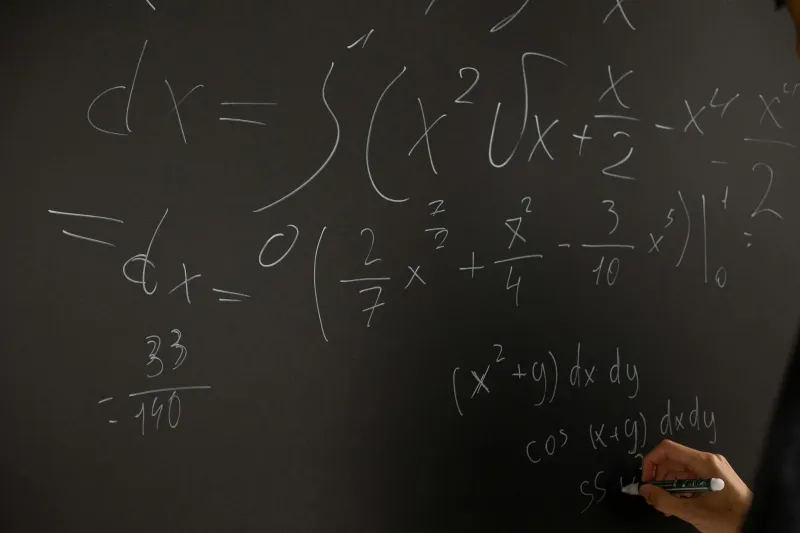
Dantzig was just another graduate student at UC Berkeley, working toward his doctorate in statistics. Like most students, he occasionally ran late to class. On this particular morning, he slipped into Professor Jerzy Neyman's lecture hall a few minutes after it had started. Not wanting to interrupt, he quietly took a seat and noticed two problems written on the blackboard.
Figuring they were the homework assignment, he copied them down and went about his day.
When Homework Becomes History
What Dantzig didn't know was that those weren't homework problems at all. They were two of the most famous unsolved problems in mathematical statistics — puzzles that had stumped the brightest minds in the field for years. Neyman had written them on the board as examples of problems that seemed impossible to crack.
But Dantzig didn't know they were impossible. So he went home and solved them.
It took him a few days longer than usual homework, but he eventually worked through both problems and turned in his solutions. When Neyman saw what his student had accomplished, he was stunned. "I told him to wrap it up in a cover and submit it as his Ph.D. thesis," Neyman later recalled.
Just like that, a case of mistaken homework became a doctoral dissertation that would change mathematics forever.
From Janitor's Son to Mathematical Revolutionary
Dantzig's path to this moment had been anything but conventional. Born in 1914 to Russian Jewish immigrants, he grew up in a working-class family in Portland, Oregon. His father worked as a janitor while studying mathematics at night, eventually becoming a professor himself. But young George showed no early signs of mathematical genius.
In fact, he was a mediocre student through much of his education. He struggled with traditional academic expectations and often felt like an outsider in academic circles. Even in graduate school, he was considered competent but hardly exceptional by his professors.
This ordinariness might have been his secret weapon. While other mathematicians approached these famous problems with the weight of their reputation on their shoulders, Dantzig tackled them with the fresh perspective of someone who simply didn't know they were supposed to be unsolvable.
The Algorithm That Runs the World
Solving those two problems was just the beginning. During World War II, Dantzig found himself working for the U.S. Air Force, tasked with figuring out how to efficiently deploy troops, supplies, and equipment across multiple theaters of war. The military had a problem: how do you optimize complex logistics when you have thousands of variables and constraints?
Traditional mathematical approaches fell short. But Dantzig saw an opportunity to apply his unconventional thinking to a real-world challenge. Working in a windowless Pentagon office, he developed what would become known as the "simplex algorithm" — a method for solving linear programming problems that could handle enormous complexity.
The breakthrough was revolutionary. For the first time, organizations could mathematically optimize their operations across multiple variables simultaneously. Want to minimize costs while maximizing output? The simplex algorithm could handle it. Need to schedule airline flights, manage supply chains, or allocate resources across a massive corporation? Dantzig's method made it possible.
The Invisible Infrastructure of Modern Life
Today, Dantzig's work is everywhere, even though most people have never heard his name. Every time you book a flight, the airline uses linear programming to optimize routes and pricing. When Amazon delivers a package to your door, Dantzig's algorithms help determine the most efficient path. The electricity powering your home, the food stocked in your local grocery store, the oil refined for your car — all of it moves through systems optimized using principles that trace back to a graduate student who showed up late to class.
Major corporations save billions of dollars annually using variations of Dantzig's methods. The U.S. military credits linear programming with dramatically improving logistical efficiency. Economists use it to model everything from market behavior to resource allocation in developing nations.
The Power of Not Knowing Better
Dantzig's story reveals something profound about innovation: sometimes the biggest breakthroughs come from people who don't know enough to be intimidated. While established experts carry the burden of knowing what's "impossible," outsiders approach problems with dangerous optimism.
This wasn't the only time Dantzig's unconventional perspective paid off. Throughout his career, he continued to tackle problems that others considered too difficult or impractical. He worked on everything from economic modeling to nuclear disarmament, always bringing the same fresh approach that had served him in graduate school.
Legacy of a Late Arrival
Dantzig eventually became a professor at Stanford University, where he continued his groundbreaking work until his death in 2005. He received numerous awards and honors, including the National Medal of Science. But perhaps his greatest achievement was proving that world-changing insights can come from the most unexpected moments.
In a field often dominated by prodigies and early bloomers, Dantzig showed that sometimes the best qualification for solving impossible problems is simply not knowing they're impossible. His accidental homework assignment became one of the most practical mathematical breakthroughs of the 20th century, touching virtually every aspect of modern life.
The next time you're running late, remember George Dantzig. Sometimes the most important discoveries happen when we're just trying to catch up — and end up changing the world instead.