She Failed the Bar Twice, Got Laughed Out of Every Firm — Then Wrote the Law That Protects 60 Million American Workers
The Letter That Changed Everything
In 1963, Martha Griffiths received her thirteenth rejection letter from a Detroit law firm. This one didn't even bother with pleasantries: "We have no positions available for women attorneys, nor do we anticipate having any in the foreseeable future."
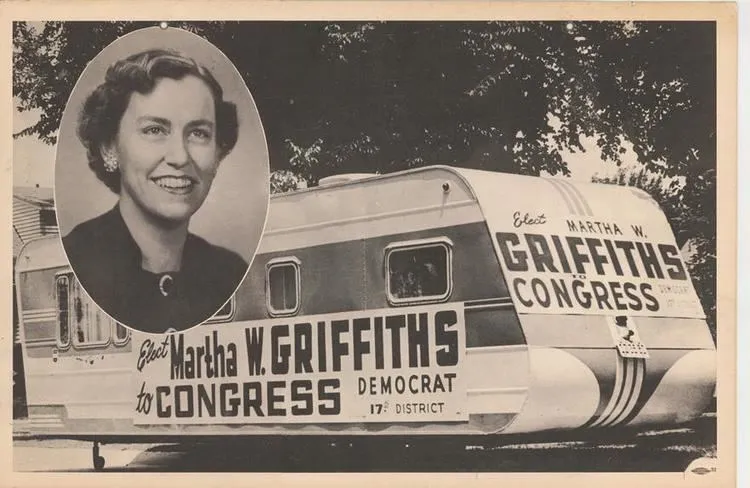 Photo: Martha Griffiths, via alchetron.com
She had failed the Michigan bar exam twice. Every major firm in the state had turned her away. Her law school professors suggested she consider teaching elementary school instead. At 41, with two children and a husband questioning her choices, Martha Griffiths seemed destined to become a cautionary tale about women who reached too high.
Instead, she became the forgotten architect of Title VII — the law that makes workplace discrimination illegal for 60 million American women.
The Student Who Wouldn't Quit
Griffiths' path to law school was already unconventional. Born in Missouri in 1912, she had worked as a high school teacher and court reporter before deciding to pursue law at age 27. The University of Missouri Law School admitted her reluctantly — she was one of only three women in her class.
 Photo: University of Missouri Law School, via law.missouri.edu
Her professors made no secret of their skepticism. "You're taking a spot from a man who could actually use this degree," one told her during her first week. Another regularly called on her with questions designed to embarrass, introducing each with, "Let's see what the lady thinks about this."
Griffiths absorbed every insult and studied twice as hard as her male classmates. She graduated near the top of her class in 1940, only to discover that academic excellence meant nothing in the real world.
The Bar Exam That Became an Obsession
Failing the bar exam once is common. Failing it twice starts to look like a pattern. Griffiths' first failure came in 1940, her second in 1941. Both times, she was convinced the graders had been harsher on her because she was a woman.
She couldn't prove it, but she could prepare for it. Griffiths spent the next year studying not just law, but the psychology of testing. She analyzed previous exams, identified patterns in the questions, and developed a systematic approach to legal writing that left no room for subjective criticism.
When she passed on her third attempt in 1942, it wasn't just a personal victory — it was a masterclass in turning systemic bias into strategic advantage.
The Firm That Finally Said Yes
After twenty-one rejections from established firms, Griffiths finally found work with a small practice that specialized in labor law. It wasn't prestigious, but it was education. She spent five years learning how employment law actually worked — not the theoretical version taught in law school, but the messy reality of workplace disputes.
She saw how employers used loopholes to discriminate. She witnessed the creative ways companies found to pay women less for identical work. She learned that most workplace discrimination wasn't dramatic or obvious — it was bureaucratic and systematic.
This wasn't the legal career she had imagined, but it was preparing her for something bigger than she knew.
The Congresswoman Nobody Expected
In 1954, Griffiths made another unlikely leap: she ran for Congress. The Democratic Party leaders in Michigan were politely dismissive. A twice-failed bar candidate with no political experience? Against an established Republican incumbent?
Griffiths won by focusing on the issues nobody else wanted to talk about: workplace fairness, equal pay, and the systematic barriers facing working women. She didn't run as a feminist candidate — the term barely existed yet — but as someone who understood how employment law actually affected ordinary families.
She would serve in Congress for twenty years, but her most important work happened in a single week in 1964.
The Amendment That Almost Didn't Happen
The Civil Rights Act of 1964 was designed to end racial discrimination. Gender wasn't part of the original conversation. In fact, when Representative Howard Smith of Virginia proposed adding "sex" to the list of protected categories, he was trying to kill the entire bill. He thought the idea of protecting women from workplace discrimination was so ridiculous that it would make the whole law unpassable.
Griffiths saw the opportunity immediately. She had spent twenty years watching women face exactly the kind of systematic workplace discrimination that the Civil Rights Act was designed to address for racial minorities. This was her chance to fix it.
Working behind the scenes, she built a coalition of supporters who understood that Smith's "poison pill" was actually a gift. When the amendment came up for a vote, Griffiths was ready with legal arguments that drew directly from her decades of experience with employment law.
Title VII passed with gender protections included. Smith's attempt to sabotage civil rights legislation accidentally created the legal foundation for workplace equality in America.
The Law That Protects Millions
Today, Title VII protects roughly 60 million American women from workplace discrimination. It makes it illegal to fire someone for being pregnant, to pay women less for the same work, or to create hostile work environments based on gender.
Most Americans who benefit from these protections have never heard of Martha Griffiths. But every woman who has filed a sexual harassment complaint, every mother who has taken maternity leave without losing her job, every female executive who has broken through a glass ceiling owes something to the lawyer who was told she had no future in law.
The Failure That Built a Legacy
Griffiths' story isn't about persistence overcoming obstacles — it's about how professional humiliation can become professional expertise. Every rejection taught her something about how the system actually worked. Every failure forced her to understand the law more deeply than her more successful peers.
When her moment came in 1964, she wasn't just a congresswoman voting on civil rights legislation. She was someone who had lived through exactly the kind of systematic discrimination the law was meant to address. Her failures hadn't held her back — they had prepared her to change the system for everyone who came after.
The woman who couldn't pass the bar exam on her first two tries wrote the law that protects millions of American workers today. Sometimes the people who struggle most to get into the system are exactly the ones who understand how to fix it.