The Dropout Who Debugged America: How a College Runaway Built the Software Empire That Runs the World's Banks
The Phone Call That Changed Everything
The conversation every college dropout dreads happened on a Tuesday in 1984. Michael Dell, nineteen years old and officially enrolled as a pre-med student at the University of Texas, had to tell his parents he was leaving school to sell computers full-time. His father, an orthodontist, had mapped out Michael's entire future: medical school, residency, a respectable practice. His mother had already started bragging to friends about her son, the future doctor.
Instead, Michael was about to become the most successful college dropout in American business history.
Sitting in his cramped dorm room, surrounded by towers of computer components and order sheets scrawled on notebook paper, Dell made the call that would launch a revolution. His parents' reaction was swift and predictable: absolute horror. "Get back to your studies," they demanded. "Stop playing with those machines."
But Dell had already tasted something his parents couldn't understand. In his first month of informal computer sales, working out of that same dorm room, he'd made more money than most of his professors earned in a year.
The Tinkerer's Epiphany
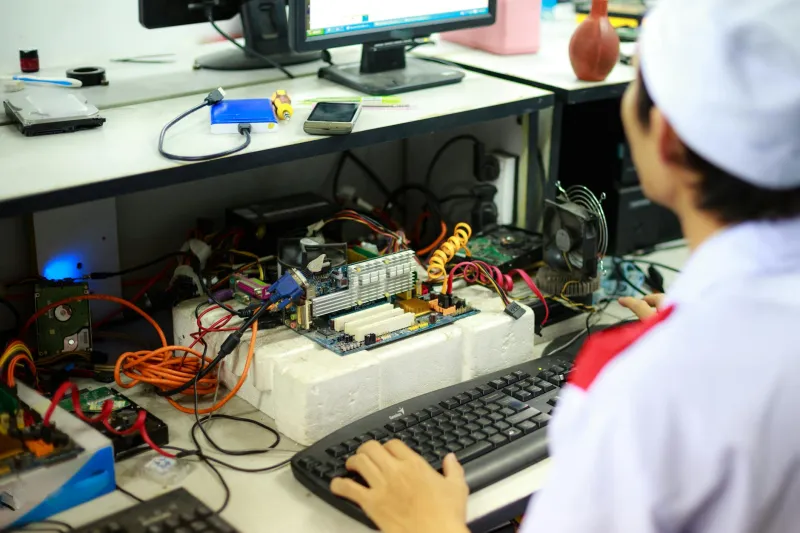
Dell's obsession with computers hadn't started in college. At fifteen, he'd bought his first PC—an Apple II—with money saved from a summer job. But instead of using it to play games or write school reports, he immediately took it apart. "I wanted to understand how it worked," he later recalled. "Every component, every connection."
What he discovered changed everything. The computer that Apple was selling for $3,000 contained parts worth maybe $600. The markup was astronomical, and Dell realized something the entire industry had missed: customers were paying premium prices for premium brand names, not premium performance.
By his senior year of high school, Dell was upgrading computers for friends and neighbors, buying components wholesale and assembling custom machines. He wasn't just fixing computers—he was reimagining how they should be sold.
Against All Conventional Wisdom
When Dell announced his intention to leave UT and start a computer company, the reaction from industry experts was unanimous: it couldn't be done. The computer business in 1984 was dominated by giants like IBM, Compaq, and Apple. These companies had massive research budgets, established dealer networks, and brand recognition that took decades to build.
Dell had none of that. What he had was something more valuable: a completely different approach.
While IBM and Compaq were selling through retailers—adding layers of markup and losing touch with actual customers—Dell decided to sell directly. No middlemen. No inflated prices. Just a phone number customers could call to order a computer built exactly to their specifications.
The concept was so simple it seemed stupid. Major computer companies spent millions on market research, focus groups, and product development cycles that lasted years. Dell would build each computer only after a customer ordered it, using the latest components available that week.
The $1,000 Revolution
Dell's entire startup capital was $1,000—money he'd saved from his dorm room computer business. He rented a small office space in Austin and hired three employees. His business plan fit on a single sheet of paper: sell better computers for less money by cutting out the middleman.
The first year was a masterclass in guerrilla marketing. Dell couldn't afford advertising in major computer magazines, so he took out small classified ads in the back pages. He couldn't compete with IBM's sales force, so he answered every customer call personally, learning exactly what people wanted and why existing computers frustrated them.
Most importantly, he discovered something that would define Dell Computer for decades: speed mattered more than anything else. While customers waited weeks or months for delivery from traditional manufacturers, Dell could build and ship a custom computer in days.
The Moment Everything Changed
The breakthrough came in 1985, less than a year after Dell had left college. A major corporation—a Texas law firm—needed to upgrade their entire computer system. Instead of going to IBM or Compaq, they called the young company that promised faster delivery and lower prices.
Dell's team worked around the clock to fulfill the order: fifty custom computers delivered in ten days. The law firm was so impressed they recommended Dell to other businesses. Word spread through Austin's professional community, then to other Texas cities, then nationwide.
By 1986, Dell Computer was generating $60 million in annual revenue. The dropout who'd disappointed his parents was now employing hundreds of people and revolutionizing an entire industry.
The Empire That Nobody Saw Coming
What happened next defied every prediction about the computer industry. While established companies struggled with inventory, distribution, and changing technology, Dell's direct-sales model became more powerful every year. They could adopt new processors faster, offer more customization options, and maintain lower prices than any traditional manufacturer.
The company went public in 1988, making Dell a millionaire at twenty-three. But the real validation came in the 1990s, when businesses and governments worldwide began choosing Dell computers over IBM and Compaq. The dropout's company wasn't just competing with the giants—it was beating them.
Today, Dell Technologies processes transactions for banks, hospitals, and governments around the world. The computer systems that manage your mortgage, your medical records, and your social security benefits likely run on Dell hardware. The company Michael Dell started with $1,000 and a willingness to ignore conventional wisdom now generates over $100 billion in annual revenue.
The Lesson Hidden in Plain Sight
Michael Dell's story isn't really about computers or technology. It's about the power of questioning assumptions that everyone else accepts as truth. While the entire industry focused on building brand prestige and dealer relationships, Dell focused on what customers actually wanted: better computers, faster delivery, lower prices.
His parents eventually forgave him for dropping out of pre-med. In fact, his father became one of his biggest supporters, often joking that his son had found a different way to help people—by making technology more accessible and affordable.
The dorm room where Dell started his revolution has been preserved at the University of Texas. It serves as a reminder that the most transformative ideas often come from the most unlikely places, championed by people willing to bet everything on a vision nobody else can see.